

How modern MCA companies meet regulatory, banking, and institutional standards – Complete 2026 MCA Compliance Checklist is at the bottom of the article.
Why 2026 MCA Compliance Determines Who Survives
The merchant cash advance industry has entered a new era.
In 2026, MCA companies are no longer judged only by how much capital they deploy or how fast they fund deals. They are judged by how safely, transparently, and compliantly they operate.
Banks are under pressure.
Payment processors are under pressure.
Institutional investors are under pressure.
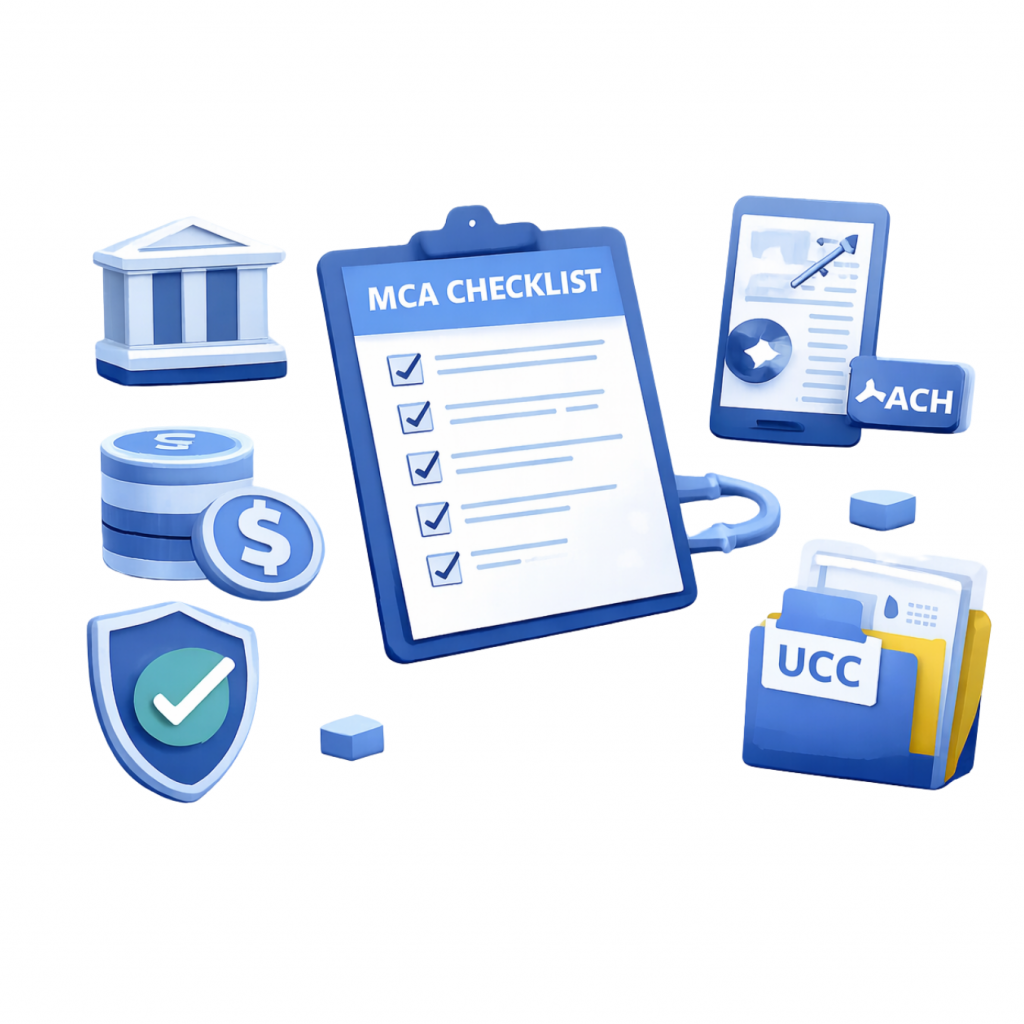
And that pressure is now being pushed directly onto MCA funders, ISOs, and platforms.
This means that 2026 MCA compliance is no longer a box to check. It is the difference between being allowed to operate — and being cut off from the financial system entirely.
MCA companies that cannot produce clean underwriting records, identity verification, payment transparency, and audit-ready reporting are being de-risked by banks and processors every single day.
This checklist exists to define what compliance really means in 2026 — and how modern platforms like LendSaaS allow MCA companies to meet those standards without drowning in manual work.
The New Regulatory Reality for MCA Companies
MCA companies are no longer operating in a regulatory gray area.
State regulators, banking partners, and institutional data providers such as Thomson Reuters and Wolters Kluwer now classify merchant cash advances as high-risk financial products. That means they are subject to many of the same data, disclosure, and risk-management standards as traditional lenders.
Banks now evaluate MCA portfolios using:
- Disclosure compliance
- UCC filing consistency
- Consumer complaint data
- Payment behavior
- Fraud signals
- Auditability of records
This is why MCA companies are being asked for things they never had to provide before:
- Underwriting logs
- Identity verification records
- ACH histories
- Contract versions
- Communication trails
These are not optional requests. They are the new baseline for bankability.
Real-World MCA Compliance Failure: The Yellowstone Capital Case
One of the most dramatic and consequential compliance failures in recent MCA industry history involved Yellowstone Capital, a group of related merchant cash advance entities that drew the scrutiny of regulators, ultimately leading to one of the largest enforcement actions ever seen in the space.
In early 2025, the New York State Attorney General’s Office, led by Letitia James, announced a $1.065 billion judgment and settlement against Yellowstone Capital and its affiliated companies over alleged predatory and non-compliant business practices. The judgment was the largest consumer protection settlement in state history outside of multistate actions, and it carried consequences far beyond a monetary penalty. New York State Attorney General
What Yellowstone Did Wrong
According to the Attorney General’s complaint, Yellowstone and its officers engaged in conduct that violated New York law, including:
- Misrepresentations about the terms of funding provided to small business owners
- Failure to disclose material terms in a transparent and legally required way
- Use of aggressive or unlawful collection practices
- Structuring deals in ways that obscured the economic reality of the transactions, effectively masking true cost and obligations from merchants
Because merchant cash advances are structured differently than traditional loans, they historically have operated in a regulatory gray zone. But regulators are increasingly treating them like credit products subject to full disclosure and consumer-protection expectations. Yellowstone’s actions, according to the AG’s office, crossed that line. New York State Attorney General
The settlement wasn’t just big — it was transformative for the industry:
- Yellowstone was required to cancel over $534 million in outstanding balances owed by small business customers
- The companies were ordered to make significant cash payments toward the judgment
- They were permanently banned from participating in the MCA industry
- They were required to vacate unsatisfied court judgments and terminate liens they had placed on small business properties
- Merchants impacted by past judgments were given instructions on how to have liens and judgments vacated
In essence, Yellowstone’s entire business model was dismantled by the enforcement action. Their officers were banned from the industry. Merchants — many of whom claimed they had been misled — were given a legal pathway to undo the economic damage caused by years of non-compliant deals. New York State Attorney General
Why This Matters for MCA Compliance in 2026
The Yellowstone case is not an outlier. It illustrates several realities that MCA operators must internalize:
1. Regulators are paying attention.
Twenty years ago, MCA products flew under the radar. Not anymore. State attorneys general and federal regulators are treating MCA arrangements as financial products that require transparent disclosures, legitimate underwriting records, and defensible compliance practices, just like loans are. JD Supra
2. Lack of compliance is not just costly — it can destroy your business.
Yellowstone wasn’t fined $1 billion simply for poor record keeping. They were penalized for actions that harmed merchants, obscured financial realities, and bypassed clear compliance obligations. The settlement effectively ended their MCA operations. New York State Attorney General
3. Banks and payment partners see these actions as risk signals.
When firms like Yellowstone are publicly exposed for compliance failures, banks and ACH partners take notice. Risk teams calculate exposure, adjust risk scoring, and often respond by tightening terms or discontinuing relationships with MCA firms perceived as high-risk.
4. Merchants can fight back.
The Yellowstone settlement included provisions allowing small business owners to petition courts to vacate liens and judgments. In other words, non-compliance doesn’t just put companies at risk — it empowers customers to unwind your revenue stack.
The Takeaway for MCA Operators
Yellowstone Capital’s downfall is a cautionary tale that underlines everything the 2026 MCA compliance checklist is designed to prevent.
When your underwriting, contracts, disclosures, and record keeping do not meet regulatory expectations:
- You face not just fines — you face industry exclusion
- You open your business to judicial actions
- You end up in settlements that wipe out receivables and destroy equity
And in 2026, regulators do not accept ignorance as a defense.
If your compliance infrastructure cannot produce clean, verified, auditable records at any moment — you are operating at risk.

What 2026 MCA Compliance Really Means
Compliance in 2026 is not paperwork.
It is proof.
You must be able to prove:
- Who the merchant is
- Where the financial data came from
- Why the deal was approved
- How the money moved
- How disputes were handled
This is the same model used by institutional compliance systems like Thomson Reuters and Wolters Kluwer, which focus on verifiable data, audit trails, and risk transparency.
MCA companies are now held to that same standard.
The 2026 MCA Compliance Framework
Modern compliance is built on systems, not people.
Every deal must be traceable.
Every document must be verifiable.
Every dollar must be accountable.
Below are the six pillars that define real 2026 MCA compliance.
1. Identity & Merchant Verification
Every funded merchant must be tied to a real, verified person and a real, verified business.
This includes:
- Government-issued ID validation
- Business entity verification
- Address confirmation
- Authorized signer verification
- Liveness and selfie checks
Fraud has evolved. Criminals now use synthetic identities, fake businesses, and manipulated documents to access capital.
Modern MCA platforms integrate tools like TruePic to ensure that uploaded IDs, selfies, and documents are authentic and unaltered.
Without this layer, underwriting risk becomes unmanageable.
2. Bank Data & Underwriting Records
Underwriting decisions must be backed by verifiable financial data.
Your system must retain:
- Original bank statements
- Transaction-level history
- Daily balances
- NSF and overdraft activity
- Cash-flow analysis
- Risk scores
- Underwriter notes
Providers such as DecisionLogic and Heron Data pull this data directly from merchant accounts and store it inside the deal record.
This creates a permanent underwriting footprint — the same type of financial traceability used by Thomson Reuters and Wolters Kluwer.
3. Contract & Disclosure Control
Every MCA transaction must have:
- A signed agreement
- Funding amount
- Payback amount
- Payment schedule
- Fee disclosures
- Merchant acknowledgements
These records must be secure, searchable, version-controlled, and tamper-resistant.
Your MCA CRM must be the system of record for every deal.
4. ACH & Payment Transparency
Banks now require full visibility into:
- When funds were sent
- When payments were collected
- When returns occurred
- When defaults began
- How balances changed
Integrations with Actum Processing and Receivabull allow every debit and credit to be logged automatically.
Manual reconciliation is no longer acceptable.
5. Servicing & Dispute Documentation
When merchants dispute a debit, MCA companies must show:
- Communication history
- Payment records
- Contract terms
- Resolution steps
- Account notes
A modern MCA platform keeps all of this tied to the deal.
6. Data Retention & Audit Trails
Every compliance-ready MCA system must log:
- Who accessed data
- Who changed records
- When changes occurred
- What was modified
This is the same standard enforced by Wolters Kluwer and Thomson Reuters.
Why MCA Companies Lose Banks
Most MCA failures are not fraud.
They are disorganization.
When a merchant disputes a debit, banks ask for proof.
When MCA companies cannot produce clean records, risk scores spike.
ACH slows.
Funds get held.
Accounts get closed.
No documents.
No audit trail.
No compliance.
No bank.
How Regulators and Banks Actually Evaluate MCA Compliance
Banks score MCA companies continuously based on:
- Data integrity
- Transaction traceability
- Fraud exposure
- Consumer complaints
- Regulatory risk
They use institutional platforms like Thomson Reuters and Wolters Kluwer to monitor:
- Merchant identities
- Transaction behavior
- Risk signals
- Compliance gaps
MCA companies that cannot provide machine-readable, verifiable data are treated as dangerous — even if they are profitable.
Why Manual Systems Are Now a Compliance Liability
Spreadsheets, inboxes, and shared drives have:
- No audit trails
- No data integrity
- No user logs
- No tamper protection
They are now red flags to banks.
Platforms like LendSaaS solve this by making every action traceable.
How a Compliant MCA Data Flow Works
A compliant MCA lifecycle looks like this:
- Merchant submits application
- Identity is verified
- Bank data is pulled
- Risk is calculated
- Underwriting is logged
- Contract is signed
- Funds are disbursed
- ACH is activated
- Payments are collected
- Servicing is tracked
- Renewals are offered
- Audit trails are preserved
This is how institutional finance works — and now it is how MCA must work.
Why Compliance Is a Growth Engine
Compliant MCA companies:
- Get higher bank limits
- Access cheaper capital
- Have fewer disputes
- Scale faster
Compliance is not a cost.
It is a profit multiplier.
How LendSaaS Enables 2026 MCA Compliance
LendSaaS acts as the single system of record for MCA companies.
It connects:
- Identity
- Bank data
- Underwriting
- Payments
- Servicing
- Reporting
- Audit trails
Every deal becomes defensible.
The Official 2026 MCA Compliance Checklist
Merchant Verification
☐ IDs verified
☐ Business validated
☐ Liveness checks
☐ Documents authenticated
Underwriting
☐ Live bank data
☐ Cash-flow analysis
☐ Risk scores
☐ Decisions logged
Contracts
☐ Signed agreements
☐ Terms stored
☐ Version control
Payments
☐ Funding tracked
☐ Debits logged
☐ Returns recorded
Servicing
☐ Communications stored
☐ Disputes documented
Audit
☐ User actions logged
☐ Data changes tracked
Final Thoughts
2026 MCA compliance is not optional.
It is the foundation of survival.
Companies that invest in modern systems will keep their banks, protect their portfolios, and scale.
Schedule a demo today and learn how LendSaaS can ensure you are always staying compliant.
Leave a Reply