
Merchant Cash Advances (MCAs) remain legal and widely used in New York State — but they are no longer lightly regulated. As of 2026, New York State MCA compliance is one of the most closely monitored areas in the alternative lending industry, driven by expanded disclosure laws, court scrutiny, and aggressive enforcement activity.
This guide breaks down what New York MCA compliance actually means, who must comply, where MCA teams most often get into trouble, and how modern operators manage compliance without slowing deal velocity.
If you fund, broker, underwrite, or support MCA transactions connected to New York State, this is required reading.
What “New York State MCA Compliance” Means (Plain English)
New York State MCA compliance does not mean MCAs are treated as loans. Instead, New York State regulates how commercial financing is offered, disclosed, and enforced — regardless of whether the product is a loan or a receivables purchase.
The centerpiece of New York State MCA compliance is the Commercial Finance Disclosure Law (CFDL), enforced by the New York Department of Financial Services.
Under this law, MCA providers and brokers must present standardized disclosures when making a specific commercial financing offer to a qualifying small business connected to New York State.
The objective is straightforward:
Give business owners clear visibility into cost, structure, and repayment — without reclassifying MCAs as loans.
Common New York State MCA Compliance Mistakes in 2026
- “We’re not based in New York State”
- “We don’t do many NY deals”
- Using outdated contract templates
- Manual disclosure workflows
- Treating compliance as legal’s problem
New York State MCA compliance is an operations issue first.
Why New York State Takes MCA Compliance Seriously
New York State did not create these rules to eliminate MCAs. The intent was to introduce discipline and transparency into a fast-growing commercial finance market.
Key drivers behind New York State MCA compliance include:
1. Inconsistent Cost Comparisons
MCAs, term loans, lines of credit, and factoring arrangements often looked completely different on paper, making it difficult for small businesses to understand total cost.
2. Contract Structures That Resembled Loans
Fixed payments, personal guarantees, and aggressive default provisions blurred the line between a receivables purchase and lending.
3. Enforcement Standardization
Disclosure laws gave regulators a neutral, consistent framework to evaluate MCA activity without banning the product outright.
For MCA operators, the takeaway is critical:
New York State allows MCAs — but expects disciplined execution.
Who Must Comply With New York State MCA Rules
Covered Parties
You are generally subject to New York State MCA compliance requirements if you are:
- A non-bank MCA funder
- An MCA broker presenting offers to merchants
- A fintech platform facilitating or underwriting MCA transactions
- Any entity making a specific commercial financing offer to a New York State-connected business
This applies to offers delivered digitally, by email, or through sales teams.
The New York State Nexus Test
MCA compliance is triggered if any of the following apply:
- The merchant’s business is principally managed or directed from New York State
- The business owner resides in New York State
- The financing is offered to a New York State-based commercial operation
This is where many MCA teams misstep — relying on incorporation state instead of actual business operations and control.
Common Exemptions (And Why Caution Still Matters)
Certain transactions may be exempt from New York State MCA disclosure requirements, including:
- Banks and federally chartered financial institutions
- Providers completing five or fewer qualifying NY transactions per year
- Transactions exceeding $2.5 million
- Financing secured entirely by real property
However, these exemptions are narrowly interpreted. Many MCA firms incorrectly assume they qualify — until regulators or courts determine otherwise.
Best practice:
Build New York State MCA compliance workflows first. Treat exemptions as secondary safeguards.
What Must Be Disclosed Under New York State MCA Compliance
New York State requires standardized, TILA-style disclosures — even though MCAs are not loans.
Required disclosure elements typically include:
- Total funds provided to the merchant
- Total amount the merchant is expected to remit
- Payment method and frequency (daily, weekly, split)
- Estimated APR (calculated using state-defined methodology)
- Fees and third-party costs
- Reconciliation or prepayment terms
- Broker involvement and compensation (if applicable)
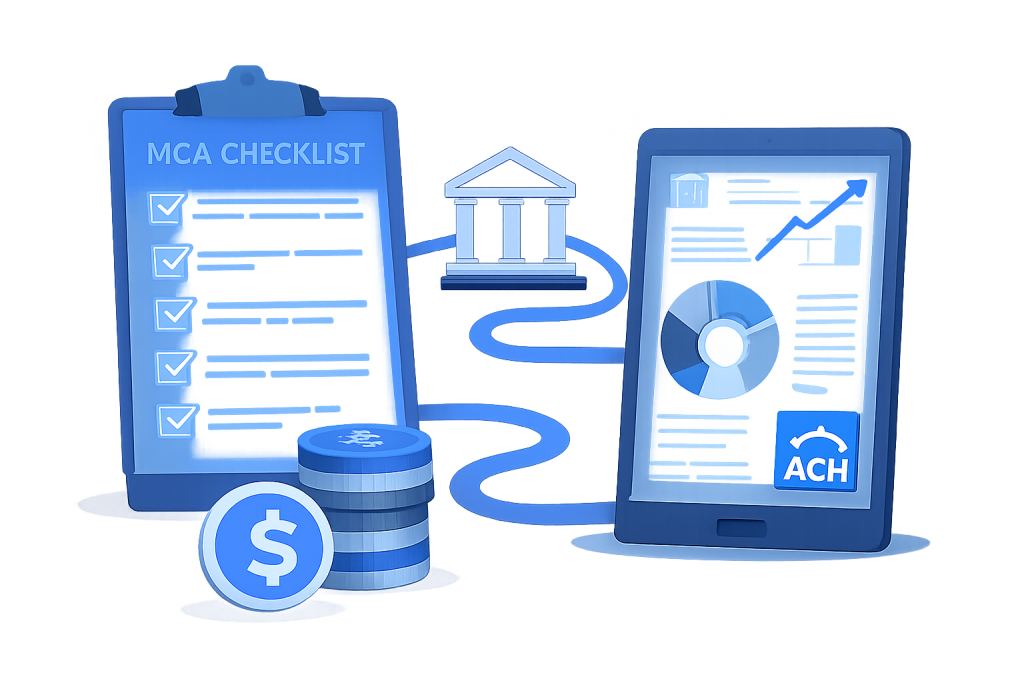
Disclosures must be presented before funding and must be affirmatively acknowledged by the merchant.
Why APR Still Matters in New York State MCA Compliance
APR remains controversial in the MCA industry — but New York State requires it regardless.
The reason is simple:
APR provides a common comparison metric, not a statement that MCAs function like loans.
From an operational standpoint, this means:
- Do not debate APR relevance
- Calculate it correctly
- Disclose it consistently
- Document merchant acknowledgment
Firms that resist this requirement tend to lose — quietly and expensively.
Contract Structure: Where New York State MCA Compliance Fails Most Often
Disclosure alone is not enough if contract economics contradict the MCA structure.
New York courts increasingly evaluate MCAs based on economic reality, not labels.

Red Flags That Trigger Loan Recharacterization
- Fixed repayment amounts unrelated to receivables
- Daily debits that never adjust downward
- Personal guarantees that eliminate meaningful risk
- Confessions of judgment or aggressive default clauses
- Lack of a functional reconciliation mechanism
If repayment is effectively guaranteed, courts may reclassify the MCA as a loan, exposing the transaction to usury claims and enforcement action.
This is one of the fastest ways MCA portfolios collapse.
Enforcement Risk in New York State (Real Consequences)
New York MCA compliance enforcement is not theoretical.
The Attorney General’s office has pursued MCA firms for:
- Misrepresenting loans as receivables purchases
- Enforcing unconscionable contracts
- Failing to provide compliant disclosures
- Using collection practices inconsistent with risk-sharing economics
Penalties have included:
- Large financial judgments
- Voided contracts
- Permanent injunctions
- Significant reputational damage

Compliance failures don’t just cost money — they kill platforms.
How Modern MCA Teams Manage Compliance
High-performing MCA operations treat compliance as infrastructure, not paperwork.
Best-Practice New York State MCA Compliance Stack
- Automated NY nexus detection
Flags merchants based on location, ownership, and operational data. - Dynamic disclosure generation
Produces compliant disclosures tied directly to offer terms. - Digital acknowledgment tracking
Timestamped, auditable confirmation before funding. - Contract version control
Prevents outdated agreements from entering circulation. - Quarterly internal audits
Reviews disclosures, contracts, and reconciliation performance.
This is where platforms like LendSaaS become operationally critical — not optional.
Broker Compliance Under New York State MCA Rules

When brokers are involved, compliance obligations increase.
Key broker-related requirements include:
- Broker compensation disclosure
- Broker-triggered disclosure obligations
- Funder liability for broker misconduct
New York State regulators do not care who caused the issue — only that it occurred.
Translation:
You are responsible for the people who bring you deals.
Common New York State MCA Compliance Mistakes in 2026
- “We’re not based in New York State”
- “We don’t do many NY deals”
- Using outdated contract templates
- Manual disclosure workflows
- Treating compliance as legal’s problem
New York State MCA compliance is an operations issue first.
FAQs
Are MCAs legal in New York State in 2026?
Do MCA companies need a New York State license?
Can MCAs charge high effective rates?
Do renewals trigger compliance?
Final Takeaway: New York State MCA Compliance Is a Growth Advantage
In 2026, New York State MCA compliance is no longer optional, informal, or ignorable. Firms that treat compliance as an afterthought face enforcement risk, operational drag, and portfolio instability.
Firms that systematize compliance gain:
- Faster deal velocity
- Stronger merchant trust
- Better broker relationships
- Lower legal risk
- Higher enterprise valuation
Schedule a demo today and see how LendSaaS can help ensure you always stay compliant!
Sources & References
- New York Department of Financial Services
Commercial Finance Disclosure Law (CFDL) guidance and enforcement materials
https://www.dfs.ny.gov/industry_guidance/commercial_finance_disclosure - New York State Attorney General
Enforcement actions and settlements involving merchant cash advances and commercial financing practices
https://ag.ny.gov/press-releases - JD Supra / commercial finance law firms
Court decisions and legal analysis on MCA loan recharacterization, disclosures, and enforcement trends
https://www.jdsupra.com
Leave a Reply