
How to Choose the Right MCA CRM Software for Underwriting, Funding, Compliance & Scale
Introduction: Why MCA CRM Software Is Now Mission-Critical
In 2026, the merchant cash advance industry is operating under more pressure than ever before. MCA CRM Software is more crucial than ever due to an increasing need for automation due to reasons such as:
Banks demanding tighter controls.
Regulators expecting clean audit trails.
Brokers wanting faster funding.
Merchants expecting a smoother experience.
At the same time, competition has exploded. There are more funders, more ISOs, and more capital chasing the same deals — which means speed, accuracy, and compliance are no longer optional.
This is why MCA CRM software has become the backbone of every serious MCA operation.
Modern MCA CRM platforms no longer just track deals. They connect underwriting, bank data, payments, compliance, and renewals into one operating system. Companies still relying on spreadsheets, email, and disconnected tools are exposing themselves to risk, missed revenue, and even loss of banking relationships.

In this buyer’s guide, we’ll cover:
• What MCA CRM software really means in 2026
• The features that matter most
• How to evaluate platforms
• The true cost of outdated systems
• And why modern platforms like LendSaaS are redefining how MCA companies scale
What Is MCA CRM Software in 2026?
At its simplest, MCA CRM software is the system that manages merchant deals. But in 2026, that definition is far too limited.
A modern MCA CRM must act as the central operating platform for the entire business, connecting:
• Lead intake
• Broker relationships
• Underwriting data
• Bank statements
• Funding and ACH
• Servicing and collections
• Renewals
• Compliance and reporting

Older CRMs were designed to store contact information and deal notes. That might have worked in 2015. In 2026, it’s dangerously inadequate.
Today’s MCA CRM software must be able to pull live bank data, verify documents, log compliance actions, integrate with payment processors, and give management a real-time view of portfolio risk.
Platforms like LendSaaS were built specifically to serve this new reality — replacing a web of disconnected tools with a unified MCA operating system.
And with all the integrations offered, LendSaaS becomes an obvious choice.
The Hidden Cost of Using the Wrong MCA CRM
Many MCA companies keep outdated systems because switching feels uncomfortable. But the true cost of the wrong MCA CRM software shows up everywhere.
Lost Deals
When underwriting takes too long, brokers send deals elsewhere. When documents go missing, merchants walk. When ACH setup is slow, funding gets delayed. A slow CRM loses revenue.
Compliance Exposure
In 2026, funders must maintain detailed records of underwriting, funding, and collections. If your CRM cannot produce audit-ready logs, you are putting your bank relationships at risk.
Operational Chaos
When sales, underwriting, servicing, and compliance all use different tools, mistakes are inevitable. A modern MCA CRM eliminates silos by giving every team a shared source of truth.
The companies that win in 2026 will not be the ones with the biggest sales teams — they will be the ones with the cleanest, fastest, and most compliant systems.
Core Features Every MCA CRM Must Have in 2026
If you are evaluating MCA CRM software, these are the capabilities that actually matter.
1. Underwriting & Bank Data Integrations
Manual bank statement review is no longer competitive. A modern MCA CRM must integrate with real-time data providers such as:
• DecisionLogic
• Heron Data
• Plaid
• Ocrolus
These tools allow you to:
• Pull bank data instantly
• Analyze cash flow
• Detect fraud
• Score risk
• Speed up approvals
Without this layer, underwriting is slow, subjective, and error-prone.
2. Identity, Document & Fraud Protection
Fraud is one of the fastest-growing threats in MCA. Your MCA CRM should integrate with tools like:
• TruePic for identity verification
• KYC and KYB providers
• Document authenticity systems
This protects funders from fake IDs, manipulated bank statements, and synthetic merchants — all of which are far more common in 2026 than most operators realize.
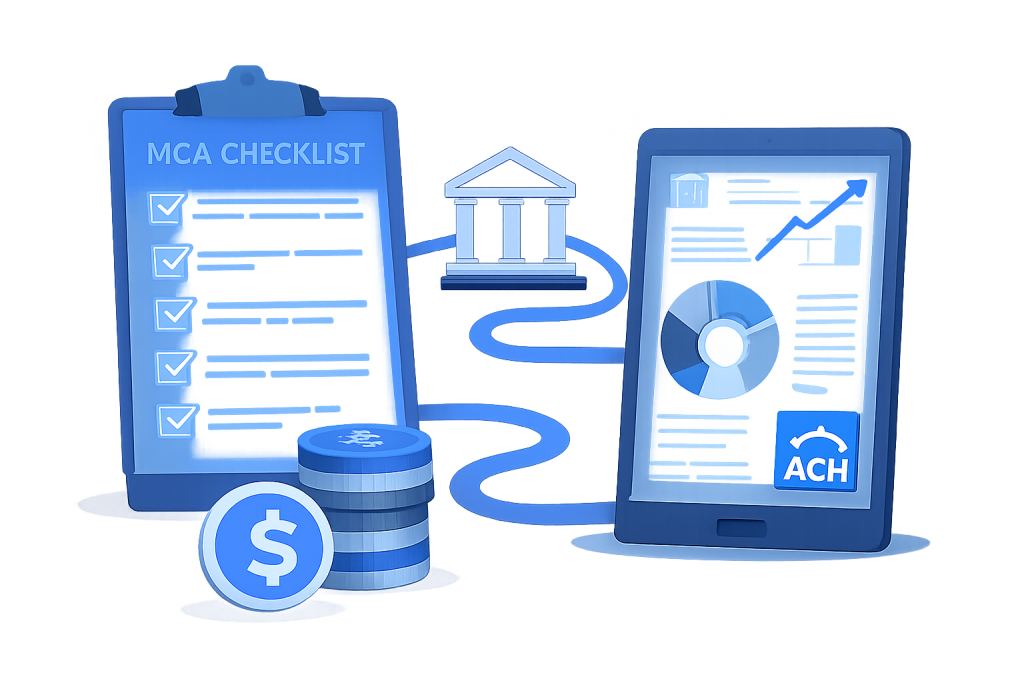
3. ACH & Payment Processing
Your CRM must connect directly to payment processors such as:
• Actum Processing
• Receivabull
• Banking APIs
This allows:
• Automated funding
• Real-time collections
• Default tracking
• Accurate reconciliation
A CRM that does not integrate with payments is not truly running your business — it is just watching it.
4. Compliance & Audit Trails
Every action in your system should be logged:
• Document uploads
• Underwriting decisions
• Bank data pulls
• ACH activity
• Contract changes
This is essential for:
• State regulators
• Banking partners
• Merchant disputes
• Investor reporting
A spreadsheet cannot do this. A modern MCA CRM must.
5. Portfolio & Renewal Management
Renewals drive MCA profitability. Your CRM should track:
• Paydown percentages
• Merchant performance
• Broker performance
• Renewal eligibility
This turns your portfolio into a predictable growth engine instead of a guessing game.
Build vs Buy: Why Custom MCA Systems Fail
Some MCA companies try to build their own internal systems. Almost all of them regret it.
Why? Because a true MCA CRM requires:
• Banking integrations
• Data provider APIs
• Security and compliance frameworks
• Hosting, backups, and redundancy
• ACH connectivity
• Regulatory reporting
By the time all of this is built, you have spent hundreds of thousands of dollars — and you are still behind platforms like LendSaaS, which were purpose-built for this industry.
Buying modern MCA CRM software is not a cost — it is risk management.
How to Compare MCA CRM Software
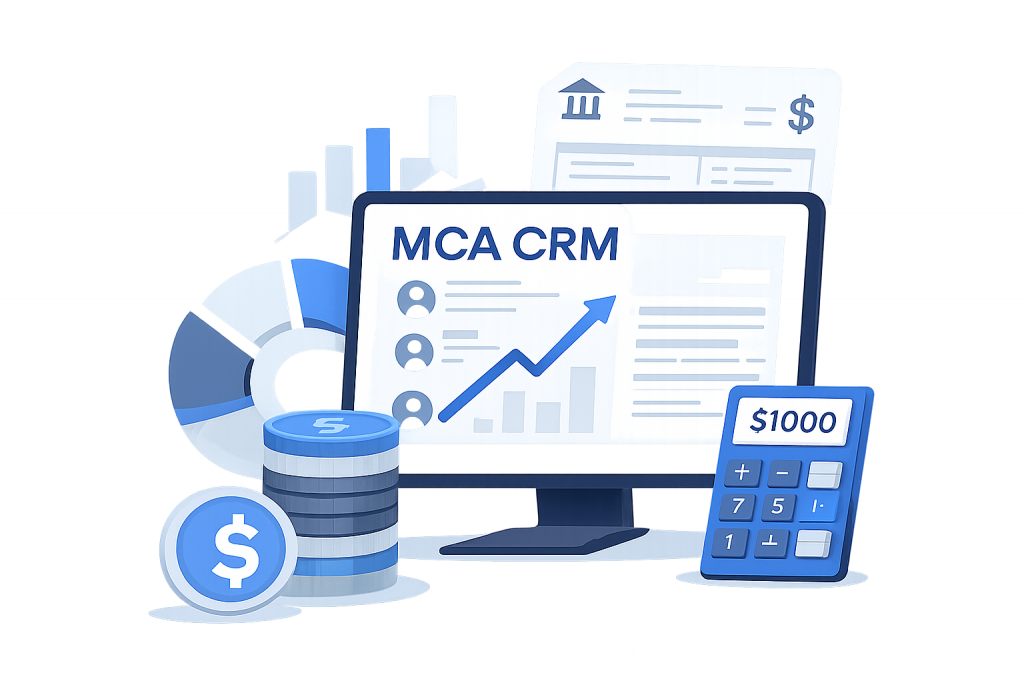
Choosing MCA CRM software in 2026 is no longer just about features — it’s about risk, scale, and survivability. Two platforms may look similar on the surface, but the differences in architecture, integrations, and data handling will determine whether your operation can grow safely or collapses under regulatory and operational pressure.
When evaluating MCA CRM platforms, ask these six questions — and don’t accept vague answers.
1. Does it integrate with my underwriting data providers?
Modern MCA underwriting depends on real-time financial data. If your CRM cannot connect directly to providers like DecisionLogic, Heron Data, Plaid, or Ocrolus, you are forcing your team to work blind.
Without live bank feeds:
- Underwriters manually download and upload statements
- Cash-flow analysis becomes slow and subjective
- Fraud becomes harder to detect
- Brokers lose confidence in your speed
A modern MCA CRM should automatically pull, store, and analyze this data inside the deal record. If underwriting data lives outside the CRM, your process is already broken.
2. Does it integrate with my ACH processor?
Funding and collections are the lifeblood of an MCA business. Your CRM must connect directly to processors like Actum Processing, Receivabull, or banking APIs so that payments, returns, and balances are tracked in real time.
Without ACH integration:
- Payments must be manually reconciled
- Defaults are discovered too late
- Portfolio reporting becomes unreliable
- Renewals are harder to manage
In 2026, if your MCA CRM does not speak directly to your money, it is not truly running your business.
3. Does it support compliance and audit trails?
Banks, regulators, and investors now expect MCA companies to prove exactly how every deal was underwritten, funded, and serviced.
That means your CRM must log:
- Document uploads
- Bank data pulls
- Underwriting decisions
- Contract changes
- Payment activity
- User actions
If your platform cannot produce a complete audit trail on demand, you are exposed — even if nothing has gone wrong yet. Compliance isn’t about avoiding fines. It’s about protecting your ability to operate.
4. Can it scale as my deal volume grows?
Many MCA CRMs work fine when you are doing 50 deals per month. Very few work when you are doing 500.
Ask:
- Can the platform handle thousands of merchants?
- Can it support multiple underwriting teams?
- Does reporting slow down at scale?
- Are integrations rate-limited or fragile?
If the system was built as a simple database instead of a platform, it will break when you grow. Scalability is not optional in 2026 — it is a survival requirement.
5. Does it support partner integrations?
Modern MCA operations depend on an ecosystem:
- Data providers
- Payment processors
- Identity verification
- Document tools
- Banks
- Analytics
Your CRM should act as the hub that connects them. Platforms like LendSaaS are designed with API-first architectures that allow you to plug in best-in-class partners instead of being locked into one vendor’s limitations.
If your CRM is closed, you are trapped. If it’s open, you can evolve.
6. Can I migrate my data cleanly?
Your MCA CRM should not hold your business hostage.
A future-proof platform allows:
- Data export
- Clean imports
- Field mapping
- Historical record retention
If moving your data is impossible or risky, the platform owns you — not the other way around. In a fast-changing regulatory and banking environment, that is a dangerous position to be in.
Why LendSaaS Is Built for the Future of MCA
LendSaaS was designed to be more than a CRM. It was built to be the operating system for MCA companies.
Instead of forcing funders to juggle:
• CRMs
• Bank portals
• Payment processors
• Data tools
• Compliance systems
LendSaaS connects them into one platform.
Through its API-first architecture, LendSaaS integrates with:
• DecisionLogic
• Heron Data
• TruePic
• Actum Processing
• Receivabull
• Banking partners
• And more
This gives MCA companies:
• Faster underwriting
• Lower fraud
• Better compliance
• Cleaner audits
• Higher renewal rates
• Stronger bank relationships
In 2026, serious MCA companies will not run on spreadsheets — they will run on platforms.
Final Thoughts
Choosing the right MCA CRM software in 2026 will determine how fast you grow, how safely you operate, and how valuable your company becomes.
The wrong platform creates friction, risk, and lost revenue.
The right platform creates speed, confidence, and scale.
Modern MCA businesses are built on systems — and platforms like LendSaaS are defining what those systems look like.
If you plan to grow in 2026, schedule a demo to try LendSaaS today!
Leave a Reply